Production
Renaissance Stages


The Italian Renaissance brought many new additions to the theatrical scenic element. A few of these elements fit very well within the script of Mandragola. Firstly, the Italian Renaissance brought the Terence Stage to the theatre. This stage consists of an "ideal city" scape as written by Vitruvius. Elements of this type of stage include the presence of three doors which are identified at the beginning of the performance and a backdrop. When Sebastian Serlio introduced perspective into theatrical design, he added wings and a floor which slanted in front of this backdrop. Serlio also introduced another important element, which detailed the type of backdrop and setting that should be used for tragic, comic, and pastoral plays. The tragic set should be formal and detailed, the comic set should show a common part of town with angled buildings, and a pastoral set should show a nature scene.
The Set of Mandragola

Mandragola takes place in Florence, Italy. The play is prefaced with a prologue that introduces the set to the audience. Other than this description, no other mentions of the set take place. They describe a door to the right which leads "to the house of a dottore who learned in Buethius a great deal of the law." This can be speculated to be the house of Messer Nicia, who is later called the Dottore. Next they describe a street which is called the Street of Love. It is described as being in a corner of the set. Then, they tell us that there is a church on the opposite side of this street, but there is no door described for this building. Finally, we are told that the door on the left belongs to Callimaco Guadagni, the lovestruck man who came back from Paris recently.
Mandragola on Stage
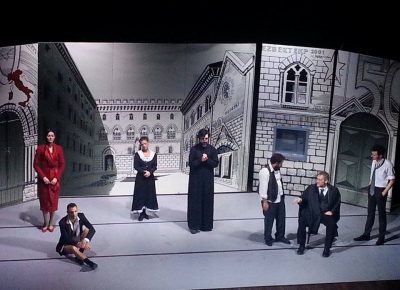

Mandragola''s first performance was in 1526, and due to the description of the set, it was probably on a form of Terence stage. From a few more context clues, the most fitting set for early performances would be on a stage like the Teatro Olimpico, which includes a backdrop of a street that could serve as the Street of Love. The church could also be included in this alley. As Mandragola is a comedy, Serlio's comic setting would have been employed in the set and backdrop. This is further suggested as the Street of Love is described as "fitted into that corner there" suggesting that there are many angles in the setting. because there are no real directions for scene changes, the play could very well take place in just this set. The stage of Terence with perspective and setting modifications from Serlio would have been the ideal place for this performance. Finally, in terms of Castelvetro's unities, the performance would have met these requirements as well. For unity of time, the actions of the play take place one after the other. If anyone was concerned about it exceeding the prescribed 24 hours, Timoteo reassures the audience "nobody will sleep here tonight, so the Acts won't be interrupted by time." It is also of note that there are no scene changes in the script, which fits with the unity of place. The script does call for some song in between acts and a few small monologues, which goes against neoclassicism. But there was a lack of fighting.
Costumes and Performers

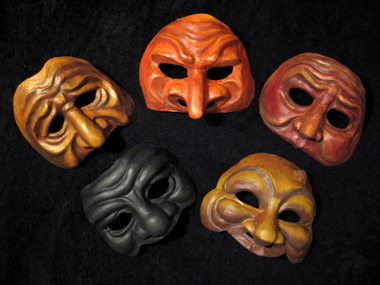
At this time, the Commedia dell'Arte was a very popular company type for comedies. It was made up of seven men and three women, which is accurate to the characters in Mandragola. This may have been a group to perform Mandragola at some point. Because the costumes were consistent with character types throughout the play, changing Callimaco's costume when he was in disguise would have been done in accordance with the costume fit to the musician. Having Timoteo put on Callimaco's costume would have accounted for that disguise. The masks that were often used to identify the characters would have been employed as well. When Callimaco was disguised, he most likely would have worn the Pantalone's mask, as described with the large nose. The others would have their own masks in accordance with their characters. Timoteo would have taken off his mask while he was pretending to be Callimaco, as the lovers never wore masks. This also means that Lucrezia would have not had a mask either.

Comments
Post a Comment